

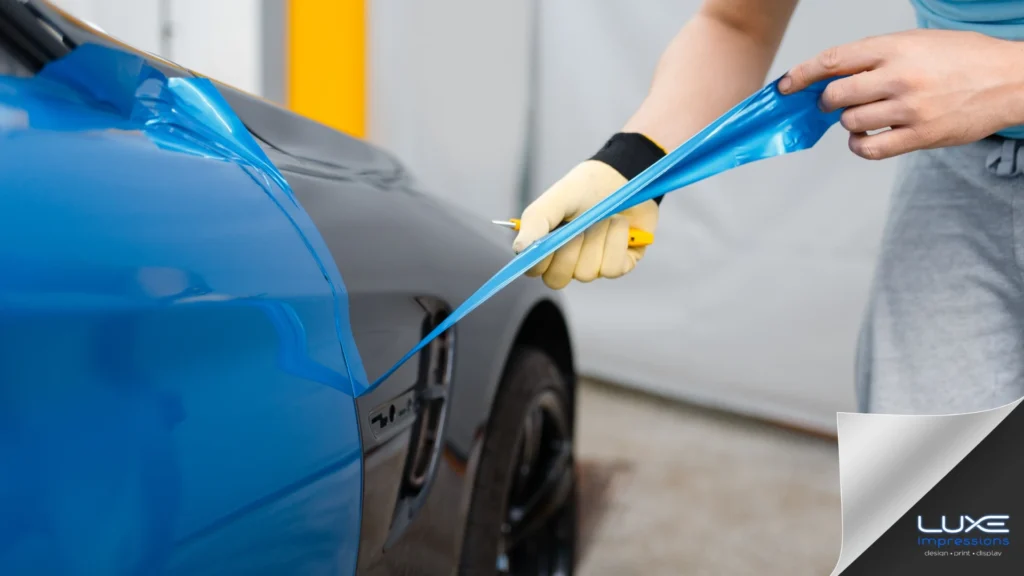
Ask not whether vehicle wraps work. They do. The question is: which type of wrap delivers the best results for your specific business, brand vision, and goals?
At Luxe Impressions, we help Woodstock and Metro Atlanta businesses make this decision daily. Full wraps command attention with complete vehicle coverage. Partial wraps deliver impact through strategic placement. Both strategies work—but they work differently.
Let’s break down the real benefits, design considerations, and practical outcomes so you can make the choice that drives your business forward.
Understanding the Difference
The distinction seems obvious at first. Full wraps cover the entire vehicle. Partial wraps cover strategic sections. But the implications of this difference extend far beyond simple coverage percentages.
What Defines a Full Wrap
A full wrap envelops every painted surface of your vehicle. Hood, roof, doors, trunk, bumpers—everything. The original paint color disappears completely beneath professional-grade vinyl. Your vehicle becomes a mobile billboard with 360-degree branding coverage.
Full wrap coverage includes:
- All body panels (doors, fenders, hood, trunk/tailgate)
- Roof surface
- Bumpers (front and rear)
- Often mirrors and door handles
- Complete color transformation
What Defines a Partial Wrap
A partial wrap covers 25% to 75% of your vehicle’s surface area. Strategic placement maximizes visibility while creating bold visual impact. The vehicle’s original paint color often becomes part of the final design.
Common partial wrap configurations:
- Three-quarter wraps: Cover sides and rear, leaving roof and hood
- Half wraps: Cover both sides with coordinating door graphics
- Spot graphics: Strategic decals on doors, tailgate, and rear windows
- Panel wraps: Full coverage of specific panels (doors only, tailgate only)
The original vehicle color isn’t a limitation—it’s a design element. Smart designers incorporate it into the overall aesthetic.
Visual Impact: What Actually Gets Noticed
Your wrap’s effectiveness depends entirely on its ability to capture attention and communicate your message. Let’s examine the visibility advantages of each approach.
Full Wrap Visibility Advantages
Complete brand immersion. Full wraps create a cohesive branded environment. No matter the viewing angle—front, rear, side, or overhead—prospects see your branding. This 360-degree presence matters in traffic, parking lots, and at job sites.
Design freedom. Full coverage eliminates constraints. Designers work with the entire vehicle as a canvas, creating flowing graphics that wrap around curves and transition seamlessly across panels. Large imagery, bold patterns, and complex designs all become possible.
Premium perception. Full wraps signal investment and professionalism. They suggest a successful business that takes its image seriously. This psychological edge matters in competitive industries.
Uniform fleet appearance. Multiple vehicles with full wraps create instant brand recognition. Your fleet becomes unmistakable whether you’re running two trucks or twenty.
Partial Wrap Visibility Advantages
Strategic focus. Partial wraps concentrate impact on high-visibility areas. The side panels your vehicle presents to adjacent traffic 90% of the time. The rear that following drivers study at stoplights. The doors that face pedestrians in parking lots.
Design efficiency. Working with the vehicle’s existing color creates striking contrast. A white van with bold blue panels. A black truck with vibrant orange graphics. The color combination grabs attention without complete coverage.
Flexible messaging. Different panels can carry different messages. Your driver’s side showcases services. Your passenger side highlights credentials. Your rear emphasizes contact information.
Visual sophistication. Well-executed partial wraps demonstrate design intelligence. They prove you understand visual communication—that you value strategy over excess.
Truth in visibility: Studies show that strategic partial wraps can achieve 70-80% of the impressions generated by full wraps, particularly in urban environments where side and rear visibility dominate.
Best Use Cases: Which Wrap Fits Your Business?
The right choice depends on your specific situation. Here’s how Atlanta businesses in different scenarios should think about this decision.
Choose Full Wraps When:
Your vehicle IS your storefront. Food trucks, mobile detailing services, mobile medical clinics, and other businesses where the vehicle serves as the primary customer touchpoint need complete branding coverage.
You compete in premium markets. Luxury services, high-end contractors, and professional services firms benefit from the elevated perception full wraps provide. Your vehicle becomes a rolling credential.
Fleet uniformity matters critically. Companies running multiple vehicles often choose full wraps for consistent appearance. Every vehicle becomes instantly recognizable regardless of make or model.
You want maximum design flexibility. If your brand requires complex graphics, large photography, or wraparound designs, full coverage provides the canvas you need.
Your vehicle color conflicts with your brand. If your company van is beige but your brand colors are navy and coral, complete coverage solves the mismatch.
Example: A Buckhead-based luxury remodeling contractor wraps their trucks completely. The premium appearance reinforces their high-end positioning and communicates quality before they ever speak with potential clients.
Choose Partial Wraps When:
Your vehicle color works with your brand. If your company van is already white and your brand colors are blue and orange, strategic partial graphics create striking contrast without complete coverage.
You want to test mobile advertising. Businesses new to vehicle marketing often start with partial wraps to gauge effectiveness before committing to full fleet coverage.
Quick turnaround matters. Partial wraps install faster, meaning less vehicle downtime. For businesses that can’t afford to have vehicles out of service for extended periods, this matters significantly.
You lease vehicles. Partial wraps typically involve less modification concern upon removal and simpler restoration at lease end.
Design simplicity serves your message. Some brands communicate better through bold, simple graphics on strategic panels than through complex full-vehicle designs.
You’re wrapping multiple vehicles. Partial wraps on six vehicles generate more total impressions than full wraps on three vehicles.
Example: A Woodstock HVAC company runs six service vans with strategic partial wraps. The combined visibility across their fleet creates dominant local presence throughout their service area.
Design Strategies for Maximum Impact
Regardless of which coverage level you choose, design execution determines results. Here’s how to maximize impact with each approach.
Full Wrap Design Principles
Tell a complete story. Use different panels for different messages. The passenger side might showcase services. The driver’s side highlights credentials. The rear emphasizes contact information.
Create visual flow. Graphics should guide the eye naturally around the vehicle. Avoid chopping images at panel breaks. Design elements should transition smoothly across seams.
Balance boldness with readability. Your company name should be legible from 100+ feet. Supporting details can be smaller but must remain readable from normal viewing distances.
Use the roof strategically. Often overlooked, roof graphics matter when your vehicles sit in traffic surrounded by taller vehicles or work at multi-story job sites.
Consider the viewing experience. Drivers approaching from behind see your rear first. Pedestrians see your side panels. Design for multiple viewing angles and distances.
Partial Wrap Design Principles
Leverage the base color. Don’t fight your vehicle’s existing color—incorporate it. Contrast creates impact. White vehicles with bold color panels. Dark vehicles with bright accent graphics.
Prioritize high-visibility areas. Focus coverage on panels perpendicular to traffic flow. Side panels catch adjacent drivers’ attention. Rear graphics engage following traffic.
Create the illusion of more. Strategic placement can make 50% coverage feel like 80%. Wrapping around panel edges and extending graphics to vehicle contours adds perceived coverage.
Make contact info prominent. With less real estate, ensure phone numbers and web addresses remain highly visible. The rear panel is prime real estate—use it wisely.
Think asymmetrically. Partial wraps don’t need identical left and right sides. Different messages on each side double your marketing opportunities.
Use negative space intentionally. Empty space isn’t wasted space—it’s visual breathing room that makes your message stand out more.
Industry-Specific Recommendations
Different industries benefit from different approaches. Here’s guidance based on business type.
Service Industries (Plumbing, HVAC, Electrical)
Recommendation: Partial wraps typically excel here.
Why: Service companies need clear contact information and service listings visible. Simple, bold partial wraps communicate professionalism without overwhelming. The focus stays on “call us when you need us” rather than complex branding stories.
Key elements: Large phone numbers, service area information, emergency availability, licensing credentials.
Food Trucks and Mobile Vendors
Recommendation: Full wraps almost always.
Why: Your vehicle IS your business. Complete coverage creates the immersive experience that attracts customers. Menu items, food photography, and brand personality all need space to shine.
Key elements: Appetizing imagery, menu highlights, operating hours, social media handles.
Professional Services (Legal, Consulting, Financial)
Recommendation: Depends on market positioning.
Why: High-end firms often choose full wraps for premium appearance. Smaller practices might use tasteful partial wraps that suggest sophistication without excess.
Key elements: Professional imagery, credentials, service specialties, easy-to-remember contact information.
Contractors and Builders
Recommendation: Mix of both across fleet.
Why: Owner vehicles and client-facing trucks benefit from full wraps. Work trucks spending time on job sites perform well with partial wraps emphasizing contact information.
Key elements: Before/after imagery, service range, licensing information, project portfolio.
Delivery and Logistics
Recommendation: Partial wraps with strategic placement.
Why: These vehicles spend most time being seen from the side and rear in traffic. Strategic panel coverage on high-visibility areas delivers maximum exposure efficiently.
Key elements: Bold company name, website, phone number, service promise.
Durability and Maintenance: Long-Term Considerations
Your wrap’s lifespan directly impacts its value to your business. Understanding durability factors helps you make informed decisions.
Expected Lifespan
Full wraps: 5-7 years with proper care
Partial wraps: 5-7 years with proper care
Spot graphics: 5-6 years with proper care
Coverage area doesn’t significantly affect durability—vinyl quality and installation expertise do. Both wrap types use the same premium materials and professional installation techniques from our vehicle graphics services.
Maintenance Requirements
Both wrap types require:
- Regular washing (avoid automatic car washes with brushes)
- Hand washing with approved cleaners
- Immediate removal of contaminants (bird droppings, tree sap)
- Parking in shade when possible
- Avoiding pressure washers above 2000 PSI
Maintenance advantage of partial wraps: Less surface area means faster cleaning and less maintenance time overall.
Damage and Repair
Full wraps: Damage to one panel requires replacing that entire wrapped section. However, the seamless coverage means repairs often blend perfectly.
Partial wraps: Damaged graphics sections are typically smaller. However, panel replacements may not match perfectly as vinyl ages and fades at different rates.
Protection consideration: Both wrap types actually protect your vehicle’s original paint from UV damage, minor scratches, and environmental wear.
The Hybrid Approach: Best of Both Worlds
Some Atlanta businesses discover that mixing wrap types across their fleet delivers optimal results.
Strategic Fleet Branding
Owner/sales vehicles: Full wraps create premium appearance for client-facing interactions.
Service fleet: Partial wraps maintain professional appearance while maximizing practical coverage across more vehicles.
Backup/older vehicles: Spot graphics provide basic branding without major investment in vehicles with limited service life.
Benefits of Mixed Approach
Visual variety creates interest. A fleet with thoughtfully varied wraps catches more attention than uniform vehicles.
Targeted messaging opportunities. Different vehicles can emphasize different services or serve different market segments.
Flexibility in fleet growth. Add vehicles gradually with appropriate wrap levels as your business expands.
Example: A property management company runs three types of vehicles—executive sedans with full wraps for client meetings, maintenance vans with partial wraps for daily service calls, and older pickup trucks with simple door graphics for supply runs.
Climate Considerations for Atlanta Vehicles
Georgia’s climate impacts wrap performance and longevity. Understanding these factors helps you maintain your investment.
Heat and Sun Exposure
Atlanta summers are brutal. Intense UV exposure and heat stress vinyl materials. Both full and partial wraps face the same environmental challenges.
Protection strategies:
- Garage parking whenever possible
- Use of UV-protective wax specifically formulated for wraps
- Regular inspection of edge lifting in high-heat areas
- Immediate repair of any lifting or bubbling
Weather Variability
Georgia weather swings dramatically. Hot summers, occasional cold snaps, humidity, and sudden storms all affect wrap longevity.
Best practices:
- Avoid washing in extreme temperatures (below 40°F or above 95°F)
- Allow wraps to cure fully before exposure to harsh weather (48-72 hours)
- Park in covered areas during severe weather when possible
Why Professional Installation Matters More Than Coverage
Here’s an uncomfortable truth: a poorly installed full wrap performs worse than a professionally installed partial wrap. Every time.
Professional installation ensures:
- Proper surface preparation and cleaning
- Correct application temperature and humidity
- Seamless panel alignment and color matching
- Proper edge sealing and tucking
- Elimination of bubbles, wrinkles, and lifting edges
- Warranty protection on materials and labor
We’ve seen too many businesses waste their investment on cheap installation that fails within months. The vinyl might be quality. The design might be brilliant. But poor installation undermines everything.
Our installation services guarantee that whether you choose full or partial coverage, your investment delivers years of reliable performance.
Making Your Decision: A Practical Framework
Consider these questions to determine your best option:
Brand Questions
- Does your vehicle serve as a storefront or just transportation?
- Does your market positioning demand premium appearance?
- How important is visual consistency across your fleet?
- Does your vehicle’s existing color complement your brand?
Design Questions
- Do you need complex graphics or simple, bold messaging?
- Can your most important information fit on strategic panels?
- Do you have compelling photography that needs showcase space?
- Will your message benefit from 360-degree visibility?
Practical Questions
- How quickly do you need the project completed?
- How much vehicle downtime can you afford?
- Will you maintain the wrap properly?
- Are your vehicles leased or owned?
Strategic Questions
- Are you wrapping one vehicle or multiple vehicles?
- Do different vehicles in your fleet serve different purposes?
- How long do you typically keep vehicles before replacement?
- What impression do you want to create in your market?
Getting Started with Luxe Impressions
Your decision between partial and full wraps shouldn’t feel overwhelming. It should feel strategic.
We help Woodstock and Metro Atlanta businesses navigate this choice daily. We’ll review your specific situation, discuss your goals, and recommend the approach that delivers maximum impact for your brand.
Our process:
- Consultation: We assess your vehicles, brand, and marketing objectives
- Design concepts: We create mockups showing both full and partial options
- Impact projection: We estimate visibility and brand exposure for each approach
- Installation scheduling: We minimize vehicle downtime with efficient timelines
- Maintenance guidance: We ensure you know how to protect your investment
Ready to transform your fleet into a mobile marketing machine?
Contact us today or call 855-456-5893 to schedule your consultation. Bring photos of your vehicles. Share your brand vision. Let’s determine whether full wraps, partial wraps, or a hybrid approach drives your business forward most effectively.
The power of mobile advertising is undeniable. The question is not whether to wrap your vehicles—the question is how to wrap them for maximum impact.
Let’s answer that question together.